
Did you know that up to 75% of people experience anxiety when they are the center of attention? It’s a biological response to being watched, and it’s often the biggest hurdle when you’re looking for overcoming camera shyness tips that actually work. You might feel perfectly confident in front of a mirror, yet the second a lens is pointed your way, your shoulders tense and your smile starts to feel forced.
It’s a common struggle to feel like the person in the photograph doesn’t match the person you know yourself to be. You want to look relaxed and authentic without the nagging fear of being judged by the person behind the camera. We understand that a great portrait isn’t just about the right lighting; it’s about creating a space where you feel safe enough to let your true personality shine through.
This article explores how to silence your inner critic and look effortlessly confident in every frame. You’ll learn how to master natural movement and understand the psychology of the “imagined observer” to reclaim your comfort. We’re sharing 15 practical strategies for 2026, from studio-ready posing secrets to mindset shifts that will help you own your next photo session with ease and poise.
Key Takeaways
- Understand why your body reacts to a camera lens as a physical threat and learn how to bypass the biological fight-or-flight response.
- Discover pre-shoot rituals like visualization and strategic outfit selection that build internal confidence before your session begins.
- Explore essential overcoming camera shyness tips that explain why a private self-photo setting removes the anxiety of being judged.
- Master practical studio techniques like the exhale and drop method to instantly relax your posture and create a natural silhouette.
- Learn a no-fuss approach to posing that helps you transition from feeling stiff to owning high-quality portraits you are proud to share.
Understanding Camera Shyness: The Science of Why We Freeze
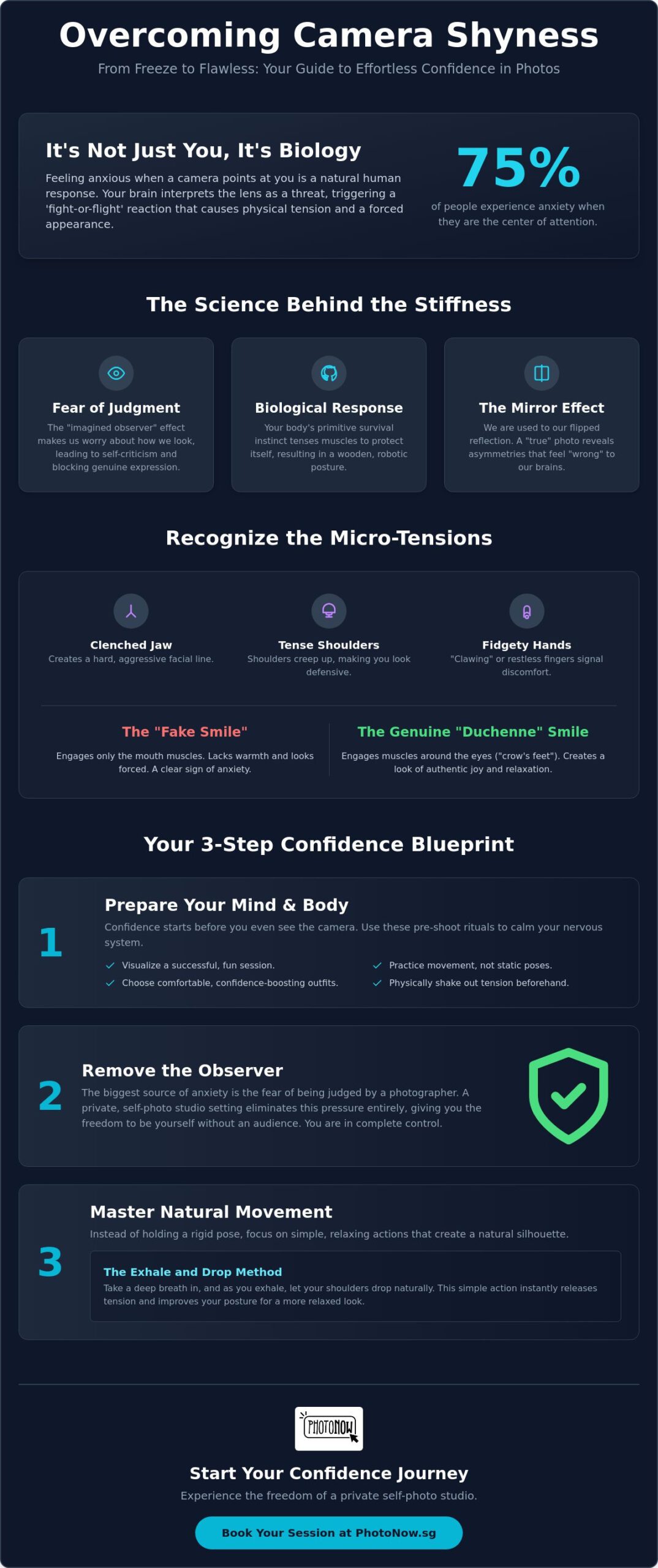
Camera shyness isn’t just a personality trait or a lack of vanity. It’s a physiological event. When a lens is pointed at you, your brain often interprets the situation as a threat. This is The Science of Why We Freeze; a primitive survival mechanism known as the fight-or-flight response. Your body tenses its muscles to protect itself, which is why your posture suddenly feels wooden and your movements become robotic. This biological reaction makes it difficult to feel relaxed, especially when you are trying to follow complex instructions while being watched.
The presence of a stranger, such as a professional photographer, often heightens this performance anxiety. You aren’t just standing in a room; you’re being evaluated by an expert. This creates a high-stakes environment where you feel the need to “perform” a version of yourself rather than simply existing. When you combine this pressure with the “Mirror Effect,” the discomfort grows. Most of us are only familiar with our flipped reflection in a mirror. When we see a “true” photo, our brain notices subtle asymmetries that feel “wrong,” leading to a cycle of self-criticism that makes overcoming camera shyness tips feel essential for anyone wanting a natural result.
The Psychological Root of Photo Anxiety
The primary driver of camera stiffness is the fear of judgment. We worry about our angles, our expressions, and whether the final image will live up to our internal self-image. This disconnect between how we feel and how we appear on a screen creates mental clutter that blocks genuine expression. Scopophobia is a common, manageable social anxiety that involves a persistent fear of being watched or looked at by others. When you understand that this fear is a shared human experience, it becomes easier to dismantle the inner critic that tells you that you aren’t photogenic.
Physical Symptoms and How to Spot Them
To master overcoming camera shyness tips, you must first recognize the “micro-tensions” that sabotage your portraits. These physical cues are your body’s way of signaling distress. You might notice them in these specific areas:
- The Jaw: Clenching your teeth creates a hard, aggressive line and makes your face look wider.
- The Shoulders: Stress causes the shoulders to creep up toward the ears, making you look defensive.
- The Hands: Fidgeting or “clawing” the fingers indicates a lack of comfort.
Pre-Shoot Rituals to Calm Your Nervous System
Preparation begins long before you step into the studio. While we previously discussed the biological roots of what is camera shyness, rituals help bridge the gap between that internal fear and external confidence. One of the most effective overcoming camera shyness tips is the practice of visualization. Spend five minutes each morning for a few days before your shoot imagining a successful, relaxed session. Picture yourself moving with ease, laughing naturally, and feeling satisfied with the results. This mental rehearsal primes your brain to treat the event as a positive experience rather than a threat.
Your wardrobe also plays a significant role in your internal state. Choose “power items” that boost your confidence, but prioritize comfort. If you’re constantly adjusting a tight collar or a restrictive skirt, that discomfort will show on your face. Strategic outfit choices reduce last-minute decision fatigue, which is a major source of pre-shoot anxiety. Additionally, many people fall into the “Mirror Practice” myth. They stand perfectly still in front of a mirror and memorize one “good” angle. This often backfires. Instead of static poses, practice movement. Shift your weight, tilt your head, and walk in place. This fluidity ensures you don’t look like a statue when the shutter clicks.
Physically shaking out the tension is another essential ritual. Before you enter the studio, take a moment to literally shake your arms and legs. This simple physical warm-up releases built-up cortisol and signals to your nervous system that it’s okay to relax. It’s a quick, no-fuss way to reset your body before the session begins.
Mindset Shifts for a Stress-Free Experience
Reframe the entire photoshoot as “play” rather than a high-stakes performance. When you focus on the purpose of the photo, such as celebrating a graduation or a new career milestone, your appearance becomes secondary to the story you’re telling. For those seeking a corporate headshot singapore, approaching the session with a “facilitator” mindset can be incredibly helpful. View yourself as a professional providing a helpful face to your brand, which shifts the focus away from self-scrutiny and toward service and reliability.
The Role of Comfort and Familiarity
Bringing a trusted friend or loved one to your session can significantly lower your stress levels. Their presence provides a sense of safety and allows for genuine interaction, which leads to more authentic expressions. It’s also vital to select a studio that prioritizes a welcoming and reassuring environment. A space that feels like a private sanctuary rather than a cold, technical lab makes it much easier to let your guard down. If you’re feeling overwhelmed, booking a professional session in a supportive environment is the fastest way to turn anxiety into a sense of accomplishment.
The Self-Photo Studio Advantage: Privacy as a Cure
For many, the most significant barrier to a great portrait is the person standing behind the camera. While professional photographers are skilled at their craft, their presence often triggers the “imagined observer” effect we discussed earlier. A self-photo studio eliminates this “watcher” entirely, replacing the audience with total privacy. This shift is one of the most effective overcoming camera shyness tips because it removes the fear of immediate judgment. When you’re alone in a professional space, you’re free to experiment without embarrassment, which allows your natural personality to surface.
Self-portraiture acts as a gentle form of exposure therapy. By taking your own photos in a high-quality environment, you desensitize yourself to the lens. You begin to see the camera as a tool for self-expression rather than a judge. Seeing your images on a monitor in real-time provides instant validation. This immediate feedback loop allows you to adjust your posture or expression on the fly, which builds a sense of mastery over your own image. Instead of wondering how you look, you can see it for yourself, which effectively silences the inner critic.
Traditional Studio vs. Self-Photo Studio
In a traditional studio setting, there’s often an unspoken pressure to perform on cue. You might worry about wasting the photographer’s time or looking foolish while trying a new pose. A self photo studio singapore offers a no-fuss alternative that prioritizes your comfort. These modern environments are designed to be intuitive and welcoming, ensuring that even the most camera-shy individuals can achieve professional results. It’s a premium experience that feels attainable and stress-free, providing high-quality portraits without the need for an audience.
Control and Empowerment Through Technology
Holding the remote shutter is a psychological game-changer. It places you in the driver’s seat, allowing you to choose the exact millisecond the photo is taken. This sense of empowerment reduces the anxiety of being “caught” in an awkward moment. Combined with professional-grade lighting and backdrops, you’ll feel more like a collaborator in your own branding and less like a subject under a microscope. The benefit of having unlimited clicks within your session means you can move through the initial stiffness and find your natural rhythm at your own pace. You aren’t just taking photos; you’re taking control of how the world sees you.
Actionable Posing Tips for a Relaxed Silhouette
Once you’ve settled into a private studio, the next challenge is knowing what to do with your body. Stiffness is the most common byproduct of anxiety, but you can counteract it with a few physical resets. One of the most effective overcoming camera shyness tips is the “Exhale and Drop” technique. Take a deep breath in, and as you breathe out, consciously let your shoulders fall away from your ears. This simple movement releases the micro-tensions in your neck and instantly makes you look more approachable and relaxed. It’s a quick fix that resets your entire silhouette in seconds.
Good posture doesn’t have to look like you’re standing at attention. Instead of pulling your shoulders back with force, focus on engaging your core. A slight engagement of your abdominal muscles naturally straightens your spine without making your limbs look wooden. If direct eye contact with the lens feels intimidating, use the “Look Away” method. Start by looking at a point just to the side of the camera or down at your feet. Gradually work your way toward the lens as you become more comfortable. This builds a sense of familiarity with the equipment at your own pace, which is much more effective than forcing a stare.
Awkward hands are often the biggest source of frustration during a shoot. If you don’t know where to put them, give them a job. Place one hand in a pocket, lightly touch your collar, or hold the remote shutter. These small actions provide a purpose for your hands and prevent them from hanging limply by your sides. When your hands are occupied, your brain has one less thing to worry about.
Dynamic Posing for Natural Movement
Static poses can feel like a trap. To achieve a candid look, try the “Walk and Turn” technique. Take a few small steps toward or away from the camera and then glance back toward the lens. This movement creates a natural flow in your clothing and expression that is impossible to replicate while standing still. Using slight angles also helps. Instead of facing the camera head-on, turn your body about 45 degrees to create a more flattering and relaxed profile. For those who want an extra layer of confidence, using a hanbok rental singapore can provide a “character” to step into. The beautiful, structured layers of traditional clothing offer a sense of poise that makes it easier to feel like you’re playing a role rather than being scrutinized.
Utilizing Props to Distract the Mind
Props are a fantastic tool for redirecting your focus. Holding a bouquet of flowers, a book, or even your graduation diploma gives your hands something to do and reduces the anxiety of being the sole focus of the frame. Chairs and stools are equally useful. They allow you to create “levels” in your posing, such as leaning forward or crossing your legs, which naturally encourages a more casual and comfortable stance. Themed sessions, like a pre-wedding or family portrait, provide a built-in narrative. When you focus on the story or the person next to you, the camera becomes a secondary observer. If you’re ready to put these techniques into practice, explore our self-photo packages to find a session that fits your needs.
Start Your Confidence Journey with PhotoNow
Applying these overcoming camera shyness tips is much easier when you have a space designed specifically for your comfort. Our studio acts as a private sanctuary where the pressure of an audience is replaced by professional-grade equipment and total autonomy. It’s the ideal environment to practice your new posing techniques and mindset shifts without the risk of judgment. Many clients find that the transition from feeling shy to becoming “camera-ready” happens naturally within a single session, as the initial stiffness melts away in the privacy of our rooms.
We pride ourselves on a “no-fuss” approach that caters to a wide range of needs. Whether you require a high-quality photo for a passport or a comprehensive family portrait, our setup ensures that your experience is seamless and stress-free. By providing you with the tools to control the shutter, we help you bridge the gap between being a subject and becoming the creator of your own image. This sense of ownership is often the final piece of the puzzle when it comes to overcoming camera shyness tips and building lasting confidence in front of any lens.
Tailored Experiences for Every Milestone
We understand that different life events carry different levels of emotional weight. For students, a graduation photo studio singapore session offers a relaxed way to celebrate academic achievements without the rigid formality of traditional photography. Similarly, our private rooms provide a perfect setting for a pre wedding photoshoot singapore. Couples can focus on their authentic intimacy and shared joy, resulting in portraits that feel genuine rather than staged. Our professional studio standards remain consistent across all packages, ensuring you receive premium results regardless of the occasion.
Your First Step Toward Camera Confidence
Booking a session with us is a straightforward process designed to respect your time and prioritize your peace of mind. When you arrive for your first private self-photo experience, our team will provide a brief, friendly orientation to the equipment before leaving you to enjoy your session in total privacy. You’ll have the freedom to experiment, laugh, and even make mistakes until you find the shots that make you feel proud. It’s important to remember that everyone is photogenic when they feel safe. By choosing an environment that values your comfort as much as the final image, you’re taking the most important step toward owning your confidence for years to come.
Reclaim Your Confidence in Front of the Lens
Mastering the art of the natural portrait begins with understanding that your anxiety is a biological response, not a personal flaw. By utilizing a private environment and practicing intentional physical resets, you can move past the stiffness that often sabotages a great photo. These overcoming camera shyness tips are most effective when applied in a space that prioritizes your comfort and autonomy over technical complexity.
Our studio provides 100% private rooms for total comfort, allowing you to experiment with different angles until you feel genuinely relaxed. With professional studio lighting and equipment already optimized for your session, you can focus entirely on your expression while using instant digital previews to track your progress in real time. It’s a seamless way to build confidence while ensuring high-quality results.
Book your private, stress-free session at PhotoNow today and discover how effortless it feels to own your image. You deserve portraits that reflect your true personality, and we’re here to provide the sanctuary you need to make that happen. Your journey toward camera confidence starts with a single, comfortable click.
Frequently Asked Questions
Why do I look so much worse in photos than in the mirror?
You look different in photos because you are seeing your “true” self rather than the flipped reflection you are used to in the mirror. This is known as the mere exposure effect. Your brain prefers the familiar mirror image, so when it sees the un-flipped version in a photo, it focuses on small asymmetries that feel “wrong.” It is a common psychological reaction that has nothing to do with how photogenic you actually are.
How can I stop my face from looking stiff when I smile?
To avoid a stiff expression, try engaging the muscles around your eyes rather than just your mouth. A genuine smile, often called a Duchenne smile, involves your whole face. You can also try pressing your tongue against the roof of your mouth or exhaling deeply right before the shot. These small physical resets help relax the jaw and create a more authentic, welcoming look in your portraits.
Is it normal to feel anxious before a professional photoshoot?
Feeling anxious is a completely normal biological response to being the center of attention. Research suggests that up to 75% of people experience some form of performance anxiety when a camera is present. Understanding that this is a shared human experience is one of the best overcoming camera shyness tips. Most people feel a bit wooden at the start of a session, but this tension usually fades as you settle into the environment.
Can I bring a friend to a self-photo studio to help me feel less shy?
Bringing a friend or a loved one is a great way to lower your stress levels and feel more at ease. Their presence provides a sense of familiarity and safety, which helps you produce genuine smiles and candid movements. Most self-photo studios accommodate small groups, making it easy to turn a solo session into a supportive and fun experience that results in more authentic photos you are proud to share.
How long does it usually take to “warm up” in front of the camera?
It typically takes about 10 to 15 minutes for your nervous system to relax and for your movements to become fluid. The first few clicks of any session are often the stiffest as you adjust to the lights and the lens. This is why many professional setups allow for unlimited shots within a set timeframe. It gives you the space to move through the awkwardness and find your natural rhythm without feeling rushed.
What should I do with my hands if I feel awkward?
The best way to handle awkward hands is to give them a specific job or “home.” You can tuck your thumbs into your pockets, lightly hold a prop like a book, or rest your hands on a stool. These actions provide a sense of purpose and prevent your arms from hanging limply. When your hands are occupied, your brain stops overthinking their placement, which leads to a much more relaxed and natural silhouette.
Are self-photo studios better for people with social anxiety?
Self-photo studios are ideal for individuals with social anxiety because they remove the pressure of being watched by a stranger. Total privacy allows you to experiment with your appearance without the fear of immediate judgment. This controlled environment is perfect for those implementing overcoming camera shyness tips at their own pace. You can take as many photos as you need until you feel confident and satisfied with the final result.
Do I need to know how to pose before I go to a studio?
You don’t need any prior knowledge of professional posing to achieve high-quality results. The most authentic portraits often come from natural movement rather than static, rehearsed positions. Most studios provide props like chairs, stools, or even themed items that naturally guide your body into flattering levels. Just focus on being yourself and moving slightly between shots; the professional lighting and setup will handle the technical side of the quality.
Recent Comments